
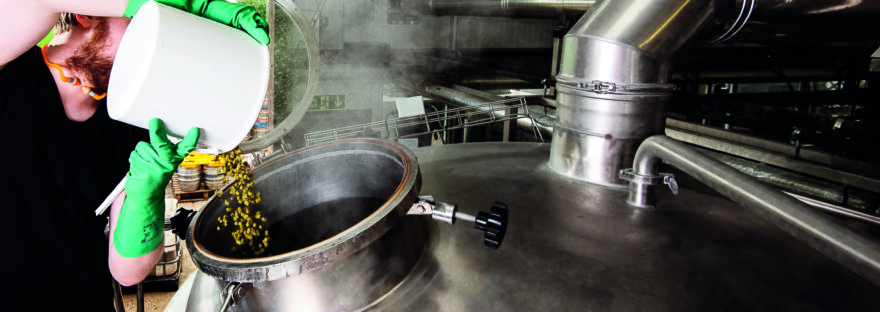
In this week’s focus blog we’re celebrating the British hop harvest, which has just begun and will likely continue until early-October. We will also be taking a look at one particularly revered product of hop harvest season: green hop beer.
Green hopped beer, sometimes known as ‘fresh hopped’ or ‘wet hopped’ beer, is beer that has been brewed using hops that are fresh from harvest. Green hops are admired for their unique flavours and oily mouth feel, a profile that can only be enjoyed in the immediate window of time that proceeds the UK hop harvest.
HARVEST TIME
The British hop harvest occurs chiefly in September, a slog of ardent labour that can easily spill into early October, picking hops at their prime and drying them out quickly for storage. It is this last step, the drying, that the hop grower forgoes as they offer fresh ‘green’ bines to brewers.
Once picked, the unique ‘green’ properties of hops can fade quick, accelerated by conventional interventions such as pelletisation – for this reason, green hops are left unpelletised or ‘whole leaf’. The opposite of green hops are conventional hops, which are dried, pelletised and packaged in ways that enable the flowers to be fragrant for up to a year.
Green or not, hops are the in-vogue agent when talking of modern beer, and it is this vibrant green plant that tops the bill when drinkers are asked to name just one ingredient used in brewing. So what exactly are hops, where did they come from and why do we use them?

AN INTRODUCTION TO HOPS
Hops are flowers that grow in bines, a member of the hemp family and a cousin species to marijuana. Hops were first used in brewing for their flavouring qualities, used interchangeably with other foragable adjuncts such as bog myrtle, yarrow, honey, spices and herbs. Thought to have been first imported for brewing around 1400, hops were introduced to the UK by Flemish traders and were domesticated soon thereafter.
Initially, new-style brews with hops were known as beer and those without hops were sold as ale. As can be observed, hops are the most recent addition to conventional brewing recipes and therefore are the only ingredient (out of hops, barley, yeast and water) that are not necessary in the production of beer (beer in its’ most basic acceptance is an alcohol beverage fermented from grain – inherently requiring cereal, water and yeast to ferment).
So why did hops displace other foragables as the primary adjunct in brewing?

The reason why hops have been so widely adopted into brewing recipes is that they are anti-microbial in nature. With the discovery of hop’s magical keeping qualities, beers were given a new lease of life, taking shelf-life from less than one week to between four to six weeks. This discovery was transformative in the brewing industry, turning a domestic chore (brewing a batch of beer was much like cooking a batch of broth) into a commercial industry, which could store commodity product for weeks – to be despatched to outlets (such as public houses) where product could be kept for weeks further.
Keeping properties and flavour/aroma contributions are just two of the four qualities that brewers celebrate in hops, the others being bittering (through isomerisation of Alpha Acids) and foam retention (the frothy head and lacing that can be seen in a glass of beer).
Hops are variety dependant, as such they are often seen as ‘the grapes of the brewing world’ with each breed exhibiting a distinct expression of where it is grown, the richness of the soil, the topography of the land, levels of sunlight and many other variable factors. Hundreds of varieties are offered commercially and each is different in both flavour and aroma. With a world of flavours awaiting, you might wonder what our very own British-grown hops have to offer..
BRITISH HOPS
British hops are known for their respectable bittering yield and grassy, herbal flavours. In regard to modern brewing, UK hops are often second choice for contemporary producers of aroma-forward pale beers, opting instead for the tropical fruit-ladened varieties of the United States, or the delicate white grape notes and bright bouquets of Australasian breeds. Though international hops are readily available for amateur and pro brewers, home-grown British hops keep a special place in the heart of many for their rich heritage and hedgerow fruit sweetness, elevating indigenous styles like stouts, porters, mild and best bitters.
In an attempt to attract contemporary brewers, UK hop growers are championing new varieties that have been bred with aroma in mind. Some new varieties such as Olicana, Jester and Harlequin have made a big splash with beer writers and discerning critics alike. In the most part, new British varieties have The British Hop Association to thank for their existence. The British Hop Association is formed of many commercial growers and offers vital research programmes that can be the proving ground for rising stars in the UK hop scene.


Regardless of their bittering/flavouring/foaming/stabilising qualities, millions of kilos of British hops are harvested each year, gracing the vessels of breweries, and eventually, the glasses of thankful beer drinkers. Of these countless bushels, a select few are reserved as green hops, to be brewed with in the hours that follow the harvest.
Conforming to nature’s ever present trade-off between fresh flavour and shelf-stability, vibrant green hop flavours must be captured immediately, with most producers aiming to brew within 24hrs of harvest. With no human intervention (drying/packing/storage) to increase shelf-life, the hops’ piquant qualities dissipate with each passing moment.
So what qualities can we expect of British green hops, and how do they taste in beer?
UNIQUE FLAVOUR
Generally speaking, green hops contribute a slick mouth feel through their increased level of oils. In terms of flavour and aroma, this differs from one variety of hop to another, though smacks of stewed fruits, hedgerow fruits and herbaceous spice are not uncommon. Common hop varieties that are offered available as ‘green’ in Britain include national staples like Fuggles, Bramling Cross and East Kent Goldings (the latter taking their namesake from a major UK hop-growing region).
The distinct flavours and slick palate of Green Hop Ale positions the style as a mythical beast in the beer world, made more elusive by its short-lived, once-yearly drinking window.
As both a lauded and short-lived product of agricultural, Green Hop Beer is inextricably linked to its locale. These links can be seen in annual celebrations of beer, culture and brewing that are hosted in the UK’s historic hop-growing territories.
THE HOME OF HOPS
Known as the ‘Garden of England’, the county of Kent is the UK’s spiritual home of hops. Kent stretches from the outskirts of Greater London down to the shores of the South East, offering coastal conditions and broad agricultural landscapes, factors that promote a fruitful cultivation of hops.
Kent is the home of the eponymous ‘Kent Green Hop Beer Fortnight‘, which sees close to thirty brewers within the county celebrate Green Hop Ale with their own spin on the style. Style is a word that can used loosely when talking about green hop beer, which can be straw-blonde and bitter or jet-black and sickly-sweet, just so long as the ale is brewed with hops fresh from the harvest. Interpretations from Kent’s many brewers offer a healthy spectrum of tipples, affording drinkers a veritable feast of flavour throughout the fortnight. Generally the beers are marked as ‘Kent Green Hop Beer’ and can be found in local pubs, bars and micropubs.

The Kent Green Hop Fortnight is underpinned by the annual ‘Kent Green Hop Beer Festival‘, an event held in Canterbury that showcases as many examples of the style as possible under one single roof. Another staple of the harvest season in Kent is the ‘Faversham Hop Festival‘, hosted in part by Shepherd Neame, England’s oldest brewer. With brewing pedigree which dates back to 1698, Shepherd Neame have seen countless hop harvests in the local area, culminating in a special green hop brew that is launched with much fanfare to local townspeople, with ancillary entertainment such as Morris dancing, parades and folk singing. The renowned Faversham Hop Festival sees approximately 40,000 visitors each year and proudly pays homage to the area’s hop-growing heritage:
“The first hop garden recorded in Kent was at Westbere in the 1523. As four Faversham merchants exported 73 pockets of hops to London in 1599 through the Port of Faversham our town or the villages around were clearly not only growing hops but growing a substantial surplus for sale. Twenty years before Faversham was importing hops from the Low Countries. In those intervening years the sourcing of hops had changed forever.” – Faversham Hop Festival website
Though there is no PGI/PDO certification for ‘Kent Green Hop Beer’, the website which is run by the fortnight’s organising body sets out the following criteria:
“1. The beer must be brewed in Kent
2. The beer can only contain Kent-grown hops
3. The beer can only flavoured with fresh, undried hops
4. The Kent hops must be used within 12 hours of picking“
It is to be noted that the above conditions only apply ‘Kent Green Hop Beers‘ – that is, those that are earmarked and featured at the annual Kent Green Hop Beer Fortnight.


FORWARD THINKING DRINKING
Just as an ale can be a ‘green hop beer’ if not brewed in Kent (just not a ‘Kent Green Hop Beer’), it can also be a brilliant representation of the style without using legacy varieties such as East Kent Goldings, Bramling Cross or Fuggles.
A growing number of green hop beers are now being produced by forward-thinking brewers, using modern techniques with new and experimental hop varieties. Upstart varieties such as Olicana, Jester and Harlequin have played lead in offers from celebrated contemporary outfits such as Five Points, Northern Monk and Wild Beer Co. Evidently, the future is bright for this historic brewing method.

ONE FOR THE ROAD
The unique flavours, aromas, and palate provided by fresh green hops are a cause for celebration and represent a true sense of place and time (or ‘terroir‘). Green hops are part of our our national gastronomic identity, take centre-stage at events that have brought communities together for centuries and are lauded by both the oldest and newest brewers in Britain.
Here’s to a fruitful harvest, and another season of green hop brewing!
CHEERS
** BONUS FUN FACT 1:
One prominent common property of hops and marijuana is that they are both soporific, meaning they induce a state of tiredness.
As a traditional working holiday, Victorian working-class parents would take their families hop-picking, whisking their clans away from the cramped conditions of the big cities and down into the Kentish countryside. Families would receive accommodation, food and drink in exchange for what was, at the time, a tough manual task that required the work of hundreds of hands.
An arduous job, children were sent to pick the hops throughout harvest time, returning to the accommodation exhausted and covered in hop matter. As the children slept soundly from a hard day’s toil peppered with soporific residue, adults drank the night away with tankards of delicious beer. Hop picking – billed as the perfect Victorian escape!
BONUS FUN FACT 2:
Hops are rarely used outside of brewing, though they are included in recipes for sleep remedies (because of their soporific qualities) and their shoots can be substituted for asparagus in cooking.
