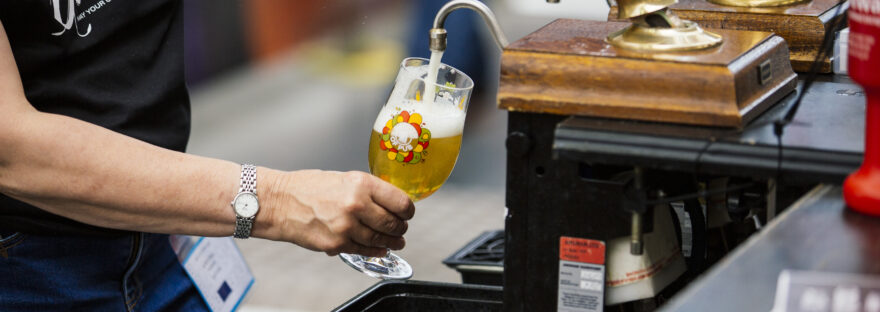
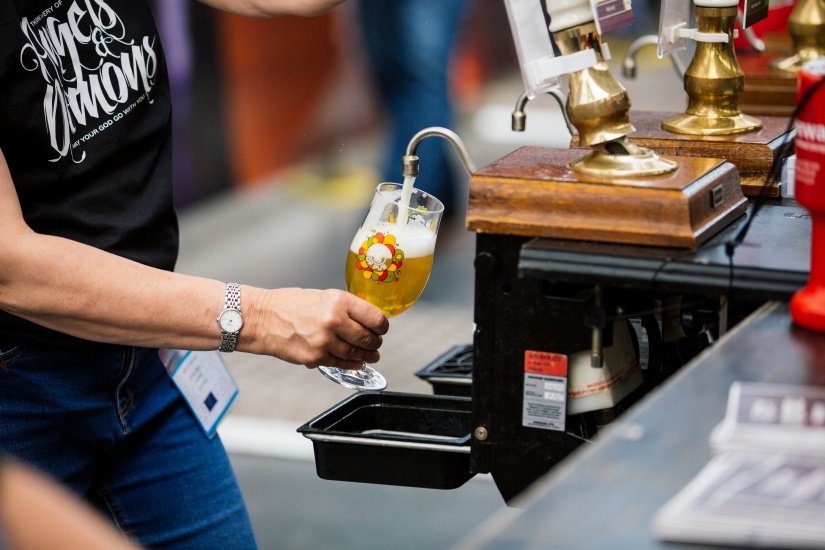
Cask Ale Week is an annual celebration of Britain’s national drink – cask conditioned beer. Happy Cask Ale Week!
Cask Ale Week acts as a yearly platform for pubs and breweries to champion real ale, through public events, incentives and other special activities that are made available to thousands of discerning drinkers.
Formed in the early noughties by Cask Marque, Cask Ale Week is supported by major trade organisations, brewers & pub groups as well as The Campaign for Real Ale (CAMRA).
The 11-day event aims to celebrate the nation’s unique heritage of cask-conditioned beer, with photos and other content to mark the occasion, shared over social media channels under the #CaskAleWeek and #StandUpForCask hashtags.
“Cask Ale Week is something round which pubs, bars, pubcos and breweries can rally. They can do their own thing, but doing it under one banner will give cut-through that’s unachievable by working alone.” – Paul Nunny, Executive Director at Cask Marque
To find your nearest #CaskAleWeek promotion, visit the official website HERE.
However, you are celebrating #CaskAleWeek, we hope you have a good one, from all of the committee at Mid-Chilterns CAMRA.
This week we are celebrating our branch’s longest-operating brewer; Tring Brewery Co.
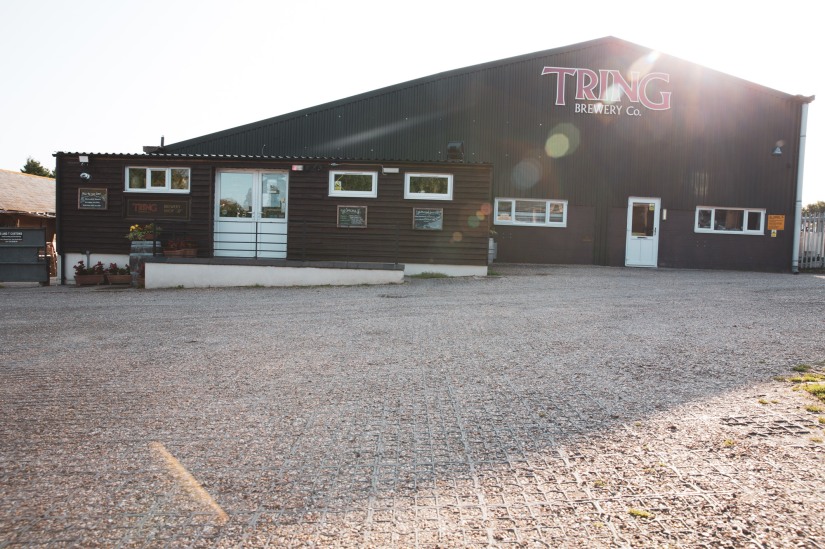
Tring Brewery Co. at Dunsley Farm, situated on London Road in Tring, Hertfordshire.
Celebrating its’ thirtieth anniversary this year, Tring Brewery was founded in 1992 by Richard Shardlow, setting up shop in a small location off Akeman Street, central to the west-Hertfordshire market town.
Richard comes from brewing pedigree as his father Peter was a brewer, with Richard himself completing a pupillage in brewing at both Ruddles and Devenish respectively, followed by a move to Greene King. Richard’s time at Greene King concluded as he joined his father Peter under the banner of Brewing Design Services, a brewery engineering company that went on to build close to 300 micro-breweries worldwide. Having globe-trotted for a number of years, Richard settled down with a brewhouse of his very own in November 1992. Tring Brewery was born.
Tring Brewery’s first beer was Ridgeway Bitter, a traditional style of English bitter that found favour with the townspeople of Tring, who had been without a brewery for over fifty years (Tring Brewery is thought to be one of many brewers who have existed in the town’s history – the last of these, Rodwells, shut in 1923).
Ridgeway Bitter is still very much a core brand to this day, though the copper-hued session beer relinquished its’ gauntlet of ‘flagship brew’ in the year 2000, the same year that saw Andrew Jackson join as co-director, jumping ship from a role in product development at Whitbread.
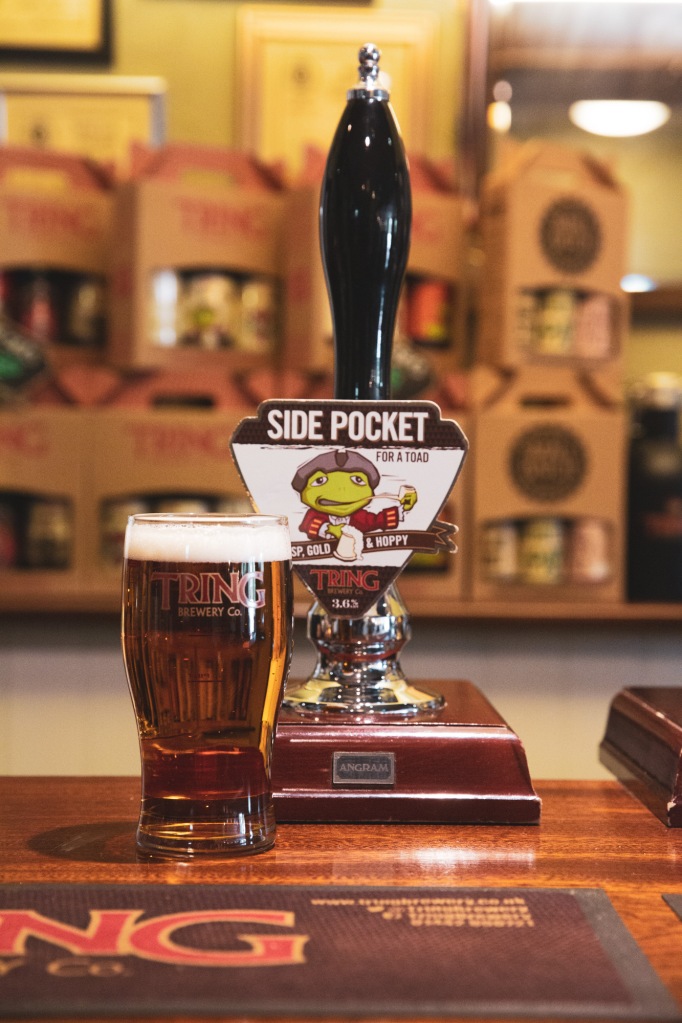
A home-counties’ favourite; Side Pocket for a Toad (3.6% golden ale).
Alongside Richard, Andrew set to work expanding Tring’s range of ‘Legendary Beer from Hertfordshire’, creating colourful brands that took their namesake and imagery from home-counties folklore. Side Pocket for a Toad was created in the year that Andrew joined and took its’ title from the Hertfordshire phrase of the same wording, alluding to the uselessness of something (“As useful as a side pocket for a toad” – much akin to ‘chocolate teapot’). As a crisp and hoppy golden ale (at a super-sessionable 3.6%) ‘Side Pocket’ grew quickly to become Tring’s flagship brand, cementing its’ place as a modern regional classic for imbibers across the home-counties.
Not before long, Tring’s set of legendary beers were propelling the brewery to new heights, and under the guise of Andrew and Richard, the brewhouse was moved to its’ expanded home on Dunsley Farm in 2010. The new space afforded the brewers with much needed capacity, alongside a dedicated brewery shop to serve takeaway draught ale and bottled beers to thirsty local drinkers.
Today’s core range of ‘legendary beer’ includes classic styles such as golden ale, bitter and stout, flanked by IPAs, barleywines and ruby ales. Tring’s core range of 11 is complemented by one of five seasonal specials and one of twelve monthly specials to boot. Tring’s monthly specials see the brewer collaborate with a local charity/non-profit organisation to inspire new beer themes and designs. In exchange for their twelve new beers, the team at Tring Brewery raises funds and awareness on behalf of their collaborator throughout the calendar year.
If Tring’s core range, seasonal special or monthly special aren’t enough to whet your appetite then their innovative keg range of Raven King IPA, Lunardi’s Pale and Alchemist Lager (brand new as-of-writing) surely will. A whopping 17 beers may be found pouring from the taps on Dunsley Farm at any one time!
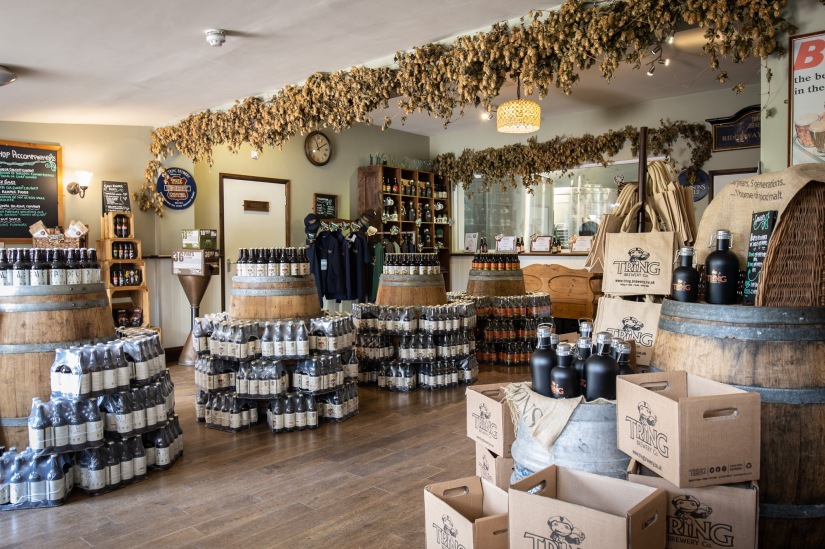
The on-site brewery shop at Dunsley Farm, adorned with freshly picked hops!
Tring’s on-site brewery shop is not just a refill station for fresh draught beer. Locally produced independent wares such as Chiltern Charcuterie (Berkhamsted), Yvette’s Chocolates (Potten End), Chiltern Artisan Biltong (Wendover) and Puddingstone Gin (Tring) commonly feature on the rustic displays and repurposed wooden barrel-tops. The shop’s booze offering is bolstered further-still by a range of ciders from the distinguished territories of Herefordshire, Gloucestershire and Somerset, with mead, merchandise, memberships and more on offer Monday through to Saturday.
Both Fridays and Saturdays see a self-service sampling bar in use at the brewery shop, with five pumps dispensing tasters completely free-of-charge. Saturdays also see the brewhouse area open for visitors with twice-monthly brewery tours. Thursday evening tours are also available as part of Tring’s event roster, featuring open tap beer and fish & chip supper for up to 35 punters per session.
Today, tours of the brewhouse reveal the original 8-barrel kit, belittled by the newer ‘main kit’ which produces 30-barrels and the newest 200l kit. The 200l ‘test kit’ was installed less than five years ago and is the all-important proving ground for Tring’s new lagers, hazy IPAs and other such styles. With the discerning drinker in mind, it is not uncommon for Tring to craft 20 new beers in a twelve month window, each produced with innovative techniques and a palate for the progressive.
The brewhouse at Dunsley Farm, gradually increasing in output.
As a decades-long champion of cask beer, Tring Brewery will always have a footing in tradition, though a passion for innovation and quality is propelling them into the future with each passing day. Here’s to thirty years of Tring Brewery, and to many more to come!
CHEERS
MID-CHILTERNS CAMRA RECOMMENDS..
A bottle or two of Tring’s Death or Glory barleywine. As both their most award-winning and strongest beer, this luscious ale is delicious and deceivingly easy drinking!
FIND THE BEERS..
The Bull (Berkhamsted), The Full House (Hemel Hempstead), Kings Arms (Tring), Monks Inn (Hemel Hempstead), Castle Inn (Tring), The Goat (Berkhamsted), The Crystal Palace (Berkhamsted), The Bell Bovingdon, Crown & Sceptre (Bridens Camp) and many more.
In this week’s spotlight blog, we’re taking a look at CAMRA’s flagship event – The Great British Beer Festival.
WHAT IS THE GREAT BRITISH BEER FESTIVAL?
Held each year in August, the ‘GBBF’ plays host to thousands of thirsty attendees, all flocking to the capital to taste up to six hundred different beers.
The very first GBBF opened its’ doors in 1977 and has done so every year since (except in 1984 – venue fire and in both 2020 and 2021 – Covid-19 pandemic).
WHERE IS THE GREAT BRITISH BEER FESTIVAL?
The Kensington Olympia in London has been home to the beer festival since 2012, with roughly 60,000 attendees catered for by a team of close to 1,000 volunteers. The London-based event is home to the ‘Champion Beer of Britain‘ awards, one the most coveted commendations among British brewers.
Prior to its’ move to the Olympia, GBBF had called many venues home, these venues include Alexandra Palace (London), Queens Hall (Leeds), Metropole (Brighton), Bingley Hall (Birmingham) and Earls Court Exhibition Centre (London).
Interior shot of the Kensington Olympia during ‘GBBF’
WHAT ELSE IS THERE AT THE FESTIVAL?
Whilst the centre-point of the Great British Beer Festival is cask ale, CAMRA caters for all tastes with cider and gin bars, keykeg and international beer bars, food, merchandise stands and an array of old-timey pub games. There truly is something for everybody!
Pub games and unusual hats – nothing is out of place at GBBF!
WHAT IS THE CHAMPION BEER OF BRITAIN?
Entertainment takes many forms at GBBF, with the festival’s annual hat day (strangest hat wins!) falling on the Thursday, a billing of musicians to keep feet shuffling around the main stage and, of course, the grand announcement of CAMRA’s ‘Champion Beer of Britain‘.
The Champion Beer of Britain award is CAMRA’s highest commendation for any cask ale, filtering entrees through regional festival competitions, judging at the Winter GBBF (sister event) and then finally on the opening day of the festival itself – Tuesday’s ‘Trade Day’. Bronze, Silver and Gold champions are declared across a plethora of styles, with gold winners battling it out to be the overall Supreme Champion Beer of Britain, conventionally announced on the Tuesday afternoon.
Surrey Hills ‘Shere Drop’ pale ale – 2019 Supreme Champion Beer of Britain
WHICH BEERS HAVE WON ‘CBOB’ IN THE PAST?
Previous ‘Champion Beer of Britain’ winners include national treasures such as London Pride (Fuller’s), Landlord (Timothy Taylor), Wherry (Woodfordes), Jeffrey Hudson Bitter (Oakham), Pale Rider (Kelham Island), Brewers Gold (Crouch Vale) and Harvest Pale (Castle Rock). Recently, the ‘Champion Beer of Britain’ award has been scooped up by relatively upstart outfits that have practiced innovative brewing to create interesting and progressive styles, styles such as Tiny Rebel’s red ale ‘Cwtch‘ and Siren Craft Brew’s coffee stout ‘Broken Dream‘ – each taking the podium within the last 5 competitions.
Winners new and old will confirm the adage that ‘CBoB’ status can make or break a brewery, with many expanding capacity and pushing themselves into overdrive simply to fulfil post-win demand from eager pubs and bars. A problem that many brewers dream of!
With so many beers to chose from, who will take supreme gold this year? Stay tuned to CAMRA’s socials channels to find out soon..
Siren Craft Brew’s ‘Broken Dream’ coffee stout, adorned with Supreme Champion status at GBBF 2018.
TIME AT THE BAR
Many champions have been forged and legends made at CAMRA’s Great British Beer Festival and this year promises to deliver it all.
As CAMRA’s flagship event returns to the Olympia after a 2 year hiatus, this year’s Great British Beer Festival is already one of the most hotly anticipated in recent memory.
Here’s to the next Champion Beer of Britain, and to CAMRA’s Great British Beer Festival!
In this week’s focus blog, we’re taking a look at the branch’s ‘Pub of the Year’ champion for 2022 – The Full House, Hemel Hempstead.
Exterior of The Full House, located on Marlowes in Hemel Hempstead town centre.
CAMRA’s ‘Pub of the Year’ awards have been highlighting the best establishments across the the UK since 1988, showcasing quality pubs to both local and travelling members and non-members. Within the national consumer organisation, all local branches are encouraged to pick their champion ‘Pub of the Year‘ alongside a runner-up and cider ‘Pub of the Year‘, with further commendations for ‘best newcomer‘ and other such categories.
Traditionally, branch committees use anonymised data from CAMRA’s digital scoring system to guide their decisions, a scoring system that is useable for any of the organisation’s 156,000 members to rate pubs, bars and social clubs out of a possible five stars. This data is then averaged out over the number of unique scores an establishment may have received before it is considered by the committee, alongside other discretionary factors, to find their annual award-winners, winners including the branch’s champion ‘Pub of the Year’.
Named after the building’s past use as a bingo hall, The Full House ticked all the boxes in this year’s awards, with beer choice, cellar management and support for local breweries each noted as exceptional.
Historic shot of the building’s past use as a bingo hall and cinema with adjoining eatery.
As a JD Wetherspoon pub, The Full House opened its’ doors on July 21st 1998, serving cask ale, bar snacks and hot meals with clinical service for nearly three decades to come. The Full House’s interior is an eclectic mix of traditional pub and art-deco, with a decorated carpet and wooden furnishings blending in seamlessly with studded metal pillars, wall murals and a giant canvas painting that depicts the last three films projected during the building’s past life as an Odean cinema.
Hemel Hempstead’s Odean Cinema was opened by the mayor of Dacorum in 1961, showing its’ very first screening ‘Doctor in Love’ with an initial seated capacity of 1,148.When construction work began in January 1959, award-winning American actress Lauren Bacall laid down the building’s foundation stone as part of a high publicity ceremony. Bacall has her very own Hollywood ‘Walk of Fame’ star, having won both a Golden Globe and a Tony award during her lifetime. As a Grammy/BAFTA/Emmy/Oscar nominee, Bacall appeared alongside the likes of Marilyn Monroe on the big screen, as well as her future husband Humphrey Bogart.
After thirty-five years as a picturehouse, the operation was converted to a split of films, food (from an eatery which was attached adjacent to the pub, structure no longer present) and bingo in the early nineties, before it’s final movie premier in 1994. The grand establishment was then reopened as a dedicated bingo hall for a further two years, before it was taken on by the JD Wetherspoon pub company and repurposed as the on-licence food and drinks premise that stands today.
Canvas painting depicting scenes from the last three films to be projected on the former Odean’s screen – Clash of Titans, Dracula and War of the Worlds. Original auditorium lighting fixtures and aesthetic grille work can be seen to the top and left of the photo respectively.
The Full House has been pouring pints throughout wholesale changes to the UK beer scene, with the emergence of local beer festivals and progressive craft beer breweries each leaving their mark on a 24 year timeline of service that has adapted and evolved to keep pace. The pub now offers five craft keg (often from local independents) alongside its’ large cask ale and real cider range, with regular events such as tap-takeovers, meet-the-brewers and cider festivals often staged for visitors of The Full House.
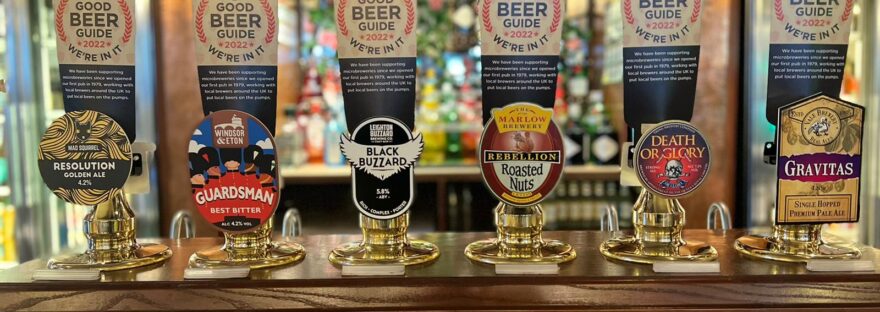
Today, eight cask lines are ever-changing with real ale, commonly occupied by local brewers such as Mad Squirrel, Tring Brewery, Rebellion, Vale and Leighton Buzzard – though it is not unusual for the cellar to be racked with national favourites such as Titanic, Oakham and Thornbridge Brewery too. Events and products are not alone as recent upgrades to this spacious town-centre establishment. Renovations to both beer gardens (yes, two!) have accompanied a complete cellar and bar front refit within the last two years. The team here do not rest on their laurels.
A not untypical line-up of beers available at The Full House, including local brewers such as Mad Squirrel, Leighton Buzzard Brewing Company, Rebellion. Tring Brewery and Vale.
Praise for The Full House is undoubtedly thanks to its’ brilliant team, though Alex the cellar manager has been singled out for his eagle-eyed management over weekly ale boards (always keeping a balanced mix of brewers and styles), and the fulfilment of insightful events that have entertained prospective consumers and ale aficionados alike.
The year 2021 saw the pub’s first ‘Family Fun Day‘, brainchild of pub manager Steph, with free kid’s entertainment, fancy-dressed staff, competitions, bake sales and more held to raise funds for charity. The pub proudly raises money for ‘Young Lives vs Cancer‘, a decades-long relationship that supports the UK’s leading cancer charity for young people and their families. Funds from these family-style events are bolstered by the many brim-full collection pots that adorn the bar front, along with regular raffles run by The Full House team. These raffles offer drinkers the chance to win hampers of beerand more from local businesses (including breweries) for the price of a small charitable donation.
The term ‘great pub‘ can mean many things to many people, each with their own criteria for a perfect experience. Some pub-goers may place beer quality and events below factors such as food service, atmosphere, community values and accessibility – we’re pleased to say that The Full House shone bright in these areas and more during 2021, leaving the branch unified in our decision.
Alex, who has worked at the pub since 2015, said: “I am delighted that the pub has won the award, which highlights our commitment and passion for real ale.”
Mid-Chilterns CAMRA Chairman Jared (right), presenting cellar manager Alex and pub manager Steph with the branch’s ‘Pub of the Year’ award for 2022.
“It is a labour of love for me to look after the real ale at The Full House – and it is great that the efforts of all the team here have been recognised.”
The Mid-Chilterns ‘Pub of the Year’ award is the branch’s highest accolade, lauded even more-so as high standards are acknowledged across the board in the local area. The committee would like to commend the efforts of all pubs in the branch throughout 2021, you certainly made it a fierce competition. To our overall winner, cheers to being our 2022 champions.
Here’s to The Full House in Hemel Hempstead – your Mid-Chilterns Pub of the Year!
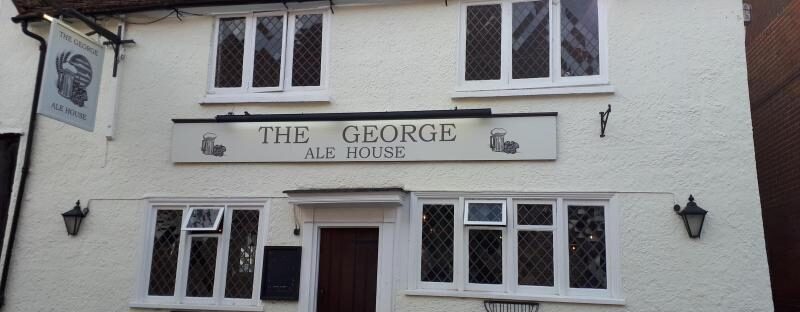
In this week’s focus blog, we’re taking a look at the branch’s runner-up champion ‘Pub of the Year’ – the George Ale House in Great Missenden.
located on High Street, Great Missenden
The George Ale House has a long history as a pub, though its’ current iteration is a phoenix from the ashes of closure, having reopened to much celebration in 2018.
In some ways you may think this pub has been open and unchanged forever, it’s interior setting a brilliant benchmark for traditional British pubs. The George Ale House boasts beautiful features such as beamed ceilings, tiled floors, roaring fires and robust wooden furnishings, including a handful of large oak casks which serve as a novel surface to rest pint after pint of delicious cask ale.
Talking of cask ale, five are turned over in quick succession at the George, including one permanent (Harvey’s ‘Sussex Best Bitter’) and four changing guests sourced both local and nationally, each kept with pride and always dispensed in tiptop condition.
Though the George is a fine example of a traditional boozer, the clientele are varied with an offer for ale anoraks and live music aficionados alike. Regular, rocking events fill an engaging calendar at the pub, worth a visit alone to spectate musical talent from near and far.
Regular entertainment in the form of live musical talentA mixture of real ale from local and national acclaim can be found at the bar
What you see is what you get at the George Ale House, an establishment that champions cask beer and everything else that a ‘proper’ pub should stand for. This is not the first award the George has received and with almost constant local acclaim this pub should poll top in any ‘Beer in Bucks’ bucket list.
Here’s to Steve and his wonderful team at the George Ale House in Great Missenden, your Runner-Up ‘Pub of the Year’ in the Mid-Chilterns for 2022!
Jared (Left, Mid-Chilterns CAMRA Branch Chairman) presenting Steve (Right, Owner/Landlord) with the Runner-Up Champion ‘Pub of the Year’ certificate for 2022.
Mid-Chilterns CAMRA are thrilled to announce our annual ‘Pub of the Year’ awards for 2022, with The Full House, Hemel Hempstead taking overall champion ‘Pub of the Year’. Congratulations to Alex (cellar manager), Steph (pub manager) and all of the team at the pub!
Our ‘Runner-Up Pub of the Year‘ has been announced as the fantastic George Ale House, based in Great Missenden. Congrats to all the team!
‘Cider Pub of the Year‘ has been awarded to Monks Inn (Hemel Hempstead), a true treasure trove of traditional farmhouse, scrumpy and playfully flavoured ciders.
Our ‘Newcomer of the Year‘ goes to the White Lion in St Leonards, a pub that has seen an amazing renovation and reincarnation to continue its’ rich history in the village.
A new award for 2022, ‘Community Pub of the Year‘ goes to The Full Moon in Hawridge for its’ outstanding efforts throughout the COVID-19 pandemic and further more for the team’s dedication to supporting local charities.
One last, but by certainly no means least, new award was ‘Off Licence Establishment of the Year‘ which is awarded to the newly opened Hops & Apples in Hemel Hempstead.
To read more about our ‘Pub of the Year’ award winners please visit our ‘Awards‘ page!
From Mid-Chilterns CAMRA to you, we would like to wish you the very best Christmas and an amazing New Years.
We would also like to commend all of the fantastic Mid-Chilternspubsand breweries that have enriched our lives over the last twelve months, we appreciate that it has been rocky and that the path ahead is not yet clear, but Mid-Chilterns CAMRA are committed to campaigning on your behalf and, of course, enjoying your lovingly kept and expertly served cask ales.
Remember, pubs aren’t just for Christmas and many will need your support in the New Year, so if you love them, pop in for a pint and some food in January to keep your beloved locals alive.
Once again thank you to all Mid-Chilterns CAMRA members for their support and participation during 2021, we wish you a very merry Christmas and a wonderful New Years!
The Good Beer Guide is CAMRA’s seminal publication featuring 4,500 of the UK’s best real-ale pubs, in rural and urban areas.
Now in its’ 48th edition, CAMRA’s publication is the best-selling beer and pub guide with a foreword from James Blunt alongside consumer features, industry analysis and a comprehensive guide to hundreds of UK breweries too!
The Good Beer Guide’s 2022 foreword is from renowned musician and publican James Blunt
As always, our nominees were curated from the highest scoring establishments on WhatPub, CAMRA’s public scoring portal which allows all members to put their local forward for awards and commendations.
Congratulations once again to all of our nominees – here’s to another fantastic edition of CAMRA’s Good Beer Guide!
Today we raise a glass to International Stout Day and dedicate this blog to the age-old question of “What is the difference between stout and porter?“
Though this question is yet to find a definitive answer, many historians have speculated on the origin of porter, and how this led to ‘stout’ as the style that we know and love today.
Porter is believed to have originated in 18th century London, when brewers were forced to create low-strength ales that were uncompromising in flavour, as taxation on malt was levied by the government (malt provides a brewer with fermentable sugars, dictating the strength of his/her beers).
Mad Squirrel Brewery’s ‘London Porter’
Increased hopping regimes and darker malts (chiefly brown malt) were employed in these weaker ales, as brewers looked to maximise their overall drinking appeal. These lower-strength beers were deep in colour with confectionary flavours and floral aromas, often matured in large oak vats, contributing additional notes of oak and vanilla (hops are antimicrobial, so increased hopping would have facilitated the extended ageing of a brew).
These luxurious dark ales won the favour of many a Londoner, no less the dockside workers that unloaded boats on the River Thames. Soon enough, loyal drinkers of the style inspire its’ namesake and ‘Porter’ as we know it was born.
As porter grew in popularity both fresh and aged, the dark style proved a prime product for export, with orders of ale brewed for long-haul shipping to the Baltic States. The brewers of London were keen to cater for this emerging market, adding new lines such as ‘Baltic Porter’ and ‘Russian Imperial Stout Porter’ to their portfolios – each using the ‘stout’ as an adjective for strong. In the form of an adjective, ‘stout’ could prefix any beer to denote a higher strength version its’ style, regardless of colour (pale, amber, dark or otherwise).
All of this begs the question that, if stout is just a reference of strength, then why do modern drinkers use the word to describe a specific style, a style that sets itself apart from traditional London Porter?
The answer is not a straightforward one, though a number of events are perceived to be key in the story of how stout and porter became two seperate entities.
The brewer’s hydrometer came into commercial use in Britain throughout the 1800s, measuring the diastatic efficiency of fermentable grains. This equipment led to the observation that pale malt was more fermentable than its’ darker counterparts, which had been kilned at higher temperatures for longer durations. As the industry learned that brown malt was not as efficient as pale malt, the idea of using brown malt alone for colour and flavour became less attractive for margin-conscious brewers.
Daniel Wheeler invented Black Patent Malt using his unique drum roaster in the year 1817. Black Patent Malt was a new style of grain that, even when used in small quantities, gave a jet-black colour to ales, with flavours of intense coffee and cocoa. This new variety of grain packed a punch and offered a perfect solution to brewers that were keen to maximise the diastatic efficiency of their dark beers. Not before long, brewers began trading off portions of brown malt in their grist for Black Patent Malt, using a pinch or two of this new, intensely dark ingredient.
Tea Kettle Stout from Tring Brewery
As sales of porter reached their Golden Age, many English brewers aired on the side of caution when altering their flagship beers, keeping brown malt in their recipes for fear of losing loyal drinkers. The loyalty of English drinkers was of no concern to Arthur Guinness, an apprentice brewer in London who, upon graduating, returned to his native city of Dublin to build Ireland’s most famous brewery.
Armed with a knowledge of diastatic efficiency, Arthur built his flagship dark ale with a base of pale and black malts only. This flagship beer was Guinness Stout Porter, a style defining beer with notes of rich coffee and dark chocolate, finishing with a dry palate and respectable bitterness.
As much a marketeer as he was a brewer, Arthur came to drop the word ‘porter’ from his product altogether and thus ‘Guinness Stout’ was born. As Guinness Stout grew into the global brand that it is today, so too did the idea that Irish Dry Stout symbolised everything that a London Porter wasn’t, dividing the timeline of the two styles thereafter.
Club Hammer Stout from Pope’s Yard
In a nutshell, porter is recognised today as a beer sweet in flavour, with notes of caramel and biscuit, deep brown in complexion with a well-rounded body. Conversely, stout is recognised as a more robust drink than porter, boasting a pitch-black complexion with roasty flavours, finishing dry and bitter on the palate.
So, there we have it – an abridged history of how porter came to be and how stout splintered away to become its’ very own style. There are still so many things that we don’t know about stout’s divergence from porter, but why let the nitty-gritty bog down our day of festivities?
Whichever style you’re drinking, raise a glass of the dark stuff to International Stout Day!
CAMRA is proud to celebrate cider all year-round and most especially in the months of May and October. These months enjoy special designation in CAMRA’s calendar with October being a time of peak cider-making that follows the harvest, and May seeing new fruits blossom alongside the tapping of now-mature cider barrels – ready for drinking in the long, hot days to come!
WHAT IS CIDER (TECHNICALLY)?
In a sentence, cider is an alcoholic beverage fermented from the juice of apples. Within the UK, alcohol can only be considered Cider if it is comprised of at least 35% apple juice, with the remaining 65% usually made up of water, added sugars, sulphites and any additional fruits/adjuncts that have been used for the enhancement of colour and flavour.
Whilst a minimum juice content of 35% is liberal enough to allow certain uber-sweet synthetically-flavoured Scandinavian ciders, it does also facilitate a drinks category that ranges from flagons of traditional scrumpy to New World sharer bottles, corked and caged with vibrant modern branding!
Though the technical definition of Cider is simple, the dynamism of its’ small-scale producers and their portfolios is at the forefront of a modern day renaissance.
WHY CIDER IS IMPORTANT TO THE BRITISH DRINKS SCENE
Today’s modern renaissance is fuelled by drinkers that are curious of flavour profile, processes and heritage – heritage that British cider-making has in spades.
It is believed that the ancestor of modern domestic apples, Malus Siversii, was spread across the world from its’ homestead of the Tian Shan mountains in Central Asia. The Malus Siversii was taken westward, initially by animals and then by humans in the form traders on the ancient silk road. Once apples had arrived in Europe, their spread was accelerated by the Roman Empire – a civilisation of keen orchard keepers. When the Romans invaded Britain, they brought with them their knowledge of orchard keeping as well as cider production, though primitive cider-making is believed to have taken place in the UK well before this.
Later down the line, cider-making represented a great interest of the Anglo Saxons, who shared their expertise of tree-husbandry with local British territories. The Anglo Saxons were also known to have deepened the flavour and complexity of cider, using new varieties of both cider-making and eating apples in their processes. In the centuries that proceeded the Anglo Saxons, acceptance and enjoyment of cider grew in Britain, earning its’ spot in the national drinks cabinet.
The Campaign for Real Ale has a dedicated ‘APPLE’ committee that celebrates real cider and perry all year round
Cider was to experience its’ most lofty elevation in the 1650s, when geopolitical blockades of wine from Spain, France and the Netherlands meant that the British aristocracy were forced to pivot on their tipple of choice. Not before long, cider was served, presented and drank like wine, assimilating into the highest echelons of society. Lords and ladies alike sipped on glass flutes of bright, effervescent cider!
Some ciders are so akin to the presentation and production of wine that, it may not be surprising to learn Méthode Champenoise may have started with British cider-makers.
Historians believe that Sir Kenelm Digby might of been the first to master secondary fermentation in bottle, showcasing his reinforced glass vessels in the year 1633. These bottles were robust enough to sustain cider that had been dosed with ‘a walnut of sugar’ before packaging. This sugar would have kick-started a second round of fermentation, injecting extra sparkle and effervescence into the bottled beverage. Sir Digby’s methods were advocated by John Beale in a presentation to members of the Royal Society in December 1662 , pre-dating Méthode Champenoise teachings from the famous monk Dom Pérignon.
Two hundred years later, Britain witnessed the emergence its’ first large-scale cider producers, fresh from the fire and brimstone of the industrial revolution. The establishment of large-scale commercial makers (such as HP Bulmers, who set up shop in 1887) soon led to further advancements in technology and processing. These rapid advances in scaling precipitated a period of industry consolidation, as the large producers became national concerns. Smaller producers remained at a grass-roots level, but a considerable gap had emerged, setting a stage for the cider landscape that we know today.
To this day, most people envision cider-making as a rural task, set in regions of gorgeous rural beauty where the practice has stood the test of time. The treasured cider counties of Somerset, Gloucestershire, Herefordshire and Monmouthshire are known for their rolling greenscapes, greenscapes that are home to countless makers (both traditional and progressive) involved in the present day Cider Renaissance.
As a quintessentially British tipple, most of the world’s Cider is still consumed in the UK, often served alongside other national staples such as vintage cheddar cheese. Cider is sewn into British culture through our national palette, collective memories and idyllic countryside daydreams. Cider is important in so many ways, and always a delectable drop – join the Cider Renaissance today!
JOIN THE ‘CIDER RENAISSANCE’ TODAY
Talking of today, smaller producers grew in number over the second half of the twentieth century, a promising trajectory that was compounded by CAMRA’s dedicated ‘APPLE’ committee – campaigning in the name of cider and perry since 1988.
Modern Cider is the product of an ongoing renaissance, built on a rich and ancient heritage. The UK cider scene is burgeoning with traditional makers and fresh upstarts, each boasting their own portfolio of delicious products. The scope of cider is widening and new audiences are waking up to the magic of fermented apple juice. Though the outcome of this modern renaissance remains to be seen, there has surely never been a greater time to enjoy cider. Cheers to CAMRA Cider Month!
WASSAIL
THREE BRITISH CIDERS THAT I HAVE ENJOYED OVER CAMRA CIDER MONTH
Duckchicken Cider, South London purchased from HopHideoutGregg’s Pit Cider, Herefordshire purchased from HopHideoutDunkertons Cider, Gloucestershire